
Birds of Mishmi Hills & Namdapha
The main focus of this tour is a birding trek through the largest protected area in the Eastern Himalayas, and third largest in India, the Namdapha National Park.
About this tour
The main focus of this tour is a birding trek through the largest protected area in the Eastern Himalayas, and third largest in India, the Namdapha National Park. However, before that we enjoy the best of lowland rainforest birding in Assam and a trip to ascend the Mishmi Hills in Arunachal Pradesh, most notably looking for the highly localised Mishmi, or Rusty-throated, Wren-babbler. First described from one specimen collected in 1947, it was not seen again until 2004.
Spread over an area of 1,985 sq km in extreme eastern Arunachal Pradesh, Namdapha National Park is seldom visited due to the difficulty of access. The area is mountainous, crisscrossed by many watercourses forming part of the catchment area of the Brahmaputra through the Noa-Dihing (Diyun) river system. The park is named after the Namdapha river, a major tributary of the Noa-Dihing. It is unique in harbouring all four big Himalayan cats: Tiger, Leopard, Snow Leopard and the rarely seen Clouded Leopard. However, the higher elevations of the park are inaccessible and our chances of seeing any of these are minimal.
A great diversity of birds however is guaranteed. This is the best site in India to see the critically endangered and declining White-bellied Heron, and we will check many of the rivers for it. Other birds could include Blyth’s Tragopan, Rufous-throated and White-cheeked Hill Partridges, Ward’s Trogon, Brown, Rufous-necked and Wreathed Hornbills, Bay Woodpecker, Pied Falconet, Blue-naped Pitta, White-crowned Forktail, Green and Purple Cochoas, Long-tailed Broadbill, Sultan Tit, Beautiful Nuthatch and Snowy-throated Babbler.
This is the perfect tour for fans of Northeast India birding who have already visited the prime hotspots of Kaziranga and Eaglenest for example—maybe on our Northeast Highlights tour, offering the best of birding further east, both lowland and upload rainforests, with many different species and a focus on some particular rare and restricted range birds.
This Bubo Birding itinerary is available through BirdWatch.info as a private or custom departure. Current dates, exact routing, accommodation and final price should be confirmed after inquiry.
Itinerary ▼
For those joining this tour directly, you will arrive in Kolkata today, with some time for local birding depending on your arrival time, and spend overnight at a comfortable hotel. Those arriving internationally at a different airport, e.g. Delhi, may need to come a day earlier: we can provide accommodation and airport transfers if required.
From Kolkata you will fly to Dibrugarh and drive to Tinsukia—on our November itinerary, there you will be meeting those of us who have been enjoying the amazing experience of Amur Falcons in Nagaland. (At other times, we often run our Eaglenest and Kaziranga tour immediately prior to this—if you have been on that, you will have arrived in Tinsukia the evening before, so today is a full day birding.) We will have time in the afternoon to bird the grassland periphery of the Dibru-Saikhowa National Park and the wetland of Maguri Beel in particular. Some difficult to see resident babblers—Marsh and Jerdon’s—and wintering bush warblers—Baikal and Spotted—are our key targets. Swamp Grass-Babbler is possible here, although our visit to Dibru-Saikhowa later in the tour has a better chance, and Bristled Grassbird has been seen in recent springs.
For our first full day’s birding, we will head inland to Dehing Patkai Wildlife Sanctuary, and the contiguous Jeypore Reserve Forest, one of the last and largest remaining lowland tropical rainforests in the country. This area is unfortunately often ignored as birders head to more well-known sites, but has an incredible diversity of species, with key targets including the highly endangered White-winged Duck, (Austen’s) Brown Hornbill and Pale-capped Pigeon. Commoner birds that we have a good chance of seeing are Sultan Tit, Pin-striped Tit Babbler, several drongos including Lesser Racket-tailed, Blue-winged Leafbird, Maroon Oriole, Common Green Magpie, Greater Necklaced Laughingthrush, Red-headed Trogon, and the tiny White-browed Piculet, whilst the many babbler species could gift us sights of White-hooded Babbler, Abbott’s Babbler, Grey-throated Babbler, and the scarce Large Scimitar Babbler. We will try in the evening to find Oriental Bay Owl—this being one of the best places for it in India—before retiring to our hotel in Digboi.
We don’t have far to go for this morning’s birding, a small area of lowland forest inside the Digboi Oilfields complex. We will be particularly searching for two species rarely seen elsewhere: Collared Treepie and the sought after Chestnut-backed Laughingthrush. Rufous-necked Laughingthrush is also regular here: whilst that, and the Treepie, may be found with luck at Namdapha, this is definitely our only chance for Chestnut-backed Laughingthrush. White-cheeked Partridge is possible here too, though far more often heard than seen, and other possibilities include Thick-billed Green Pigeon, Square-tailed Drongo Cuckoo, Black-winged Cuckooshrike, and Blue-throated and Pale-chinned Blue Flycatchers. We will then drive northeast, across the Brahmaputra on the new Dhola–Sadiya Bridge, the longest bridge in India, to the town of Roing at the base of the Mishmi Hills. The northern tributary, the Dibang river, provides access to extensive swampy grasslands. We will spend some time birding these areas, probably near Jia or Nijamgarh, in particular looking for Bengal Florican. Always difficult to find due to their secretive habits, our best chance is often for a bird flying over the grassland or, with luck, from a small watchtower constructed by enterprising locals. Lesser Coucal, Yellow-bellied Prinia, Spotted Bush Warbler, Jerdon’s, Chestnut-capped, Marsh and Striated Babblers, and Black-breasted Parrotbill, are all key birds to look for here.
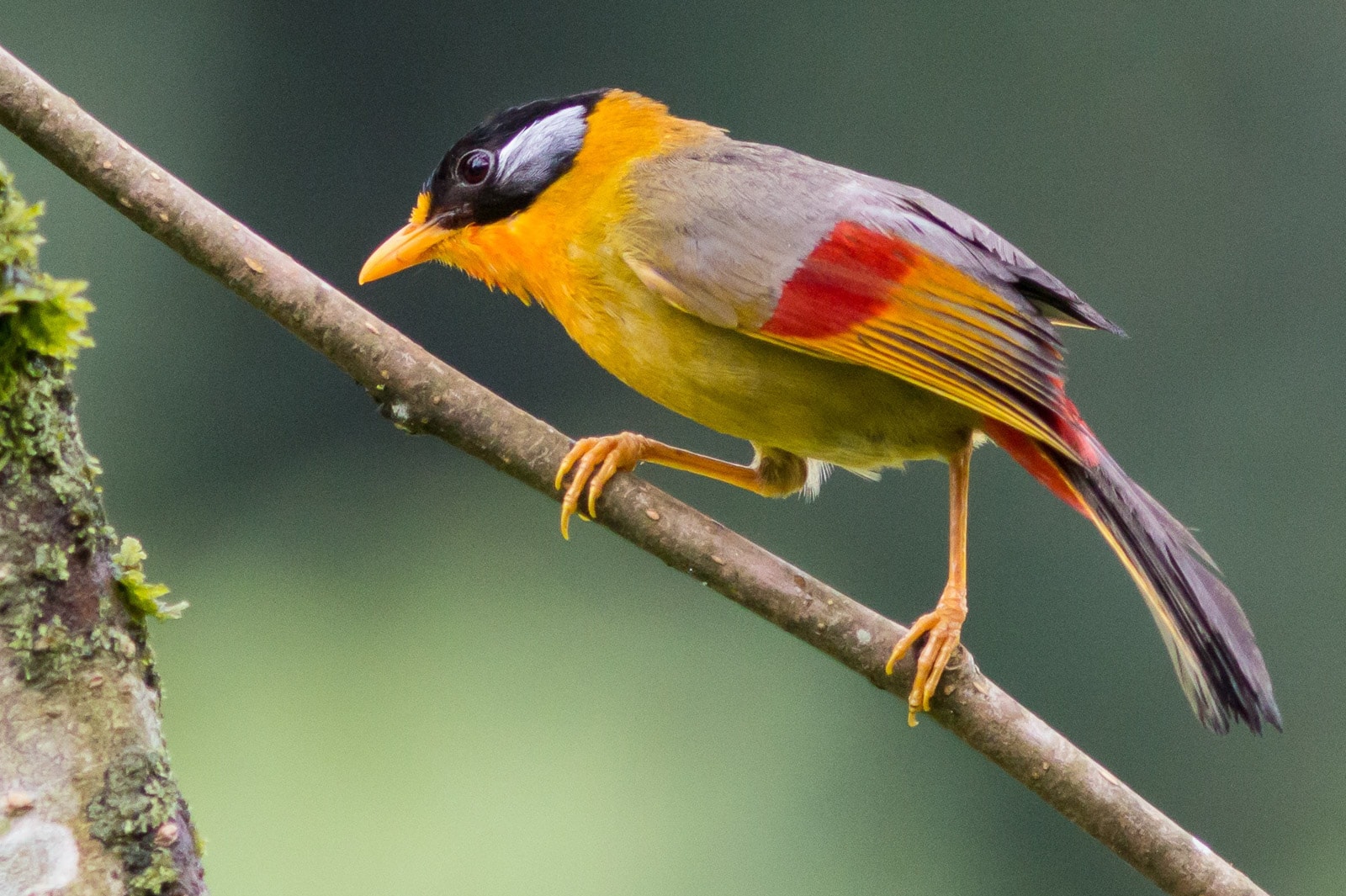
Today we head up in altitude, birding at various elevations as we go and noting changes of birdlife throughout. We will look for birds such as Red-headed Trogon, White-browed Piculet, Long-tailed Broadbill, Blyth’s Shrike-Babbler, Sultan Tit, Mountain Tailorbird, Grey-bellied Tesia, Chestnut-crowned Warbler, Coral-billed Scimitar Babbler, Cachar Wedge-billed Babbler, Long-billed Wren-Babbler, Spot-throated Babbler, Rusty-fronted Barwing, Silver-eared Mesia, Red-faced Liocichla, Beautiful and Long-tailed Sibias, Beautiful Nuthatch, Purple and Green Cochoas, White-gorgeted Flycatcher, Hill Blue Flycatcher, Large Niltava, White-tailed Robin and Slaty-backed Forktail. We will continue up to our overnight halt for the next three nights, the bizarre Mayodia Coffee House!
The Mayodia Pass at 2,666 m is the highest point on the road in this part of eastern Arunachal Pradesh. Sclater’s Monal is a very rarely encountered species in India, with the few records usually coming from near the Mayodia Pass. We have two full days to spend in this general area and, depending how keen people are to see this, we may well try one early morning tough trek to give us the best chance of finding it. Our November departures tend to be more successful, for sightings then are more frequent from the road itself, but in the spring it takes effort and luck! Other good species here include Blyth’s Tragopan (again heard more often than seen, but with a better chance of views than the monal!), Himalayan Owl, Slender-billed Scimitar Babbler, Ward’s Trogon, Grey-sided and Spotted Laughingthrushes, Gould’s and Rusty-bellied Shortwing, Fire-tailed Myzornis and, of course, our main target, Rusty-throated or Mishmi Wren-Babbler. This was known from just a single specimen collected in the 1940s until it’s rediscovery in 2004. It appears to be locally common although, as with all wren-babblers, we might need some luck to get clear views.
Our day to leave Mishmi Hills and our birding plan will largely depend on what we have and haven’t managed to see over the past few days. We may spend more time at Mayodia Pass (maybe for a final attempt at Sclater’s Monal!) or again try one of the grassland areas near Roing, before we enter the Namdapha National Park. Namdapha National Park and Tiger Reserve in eastern Arunachal Pradesh is one of the largest wilderness areas in south Asia. Thick and often impenetrable tropical rainforest is broken by bamboo thickets and numerous rivers and streams of the Noa-Dihang and Namdapha rivers. The park covers a vast altitudinal range, up to about 4,500 m, and supports more than half of India’s land mammals, including being the only place in the world with four species of big cats. It is no surprise that Namdapha harbours an impressive bird list, and we will search throughout for species including Grey Peacock Pheasant, Ibisbill, the highly endangered White-bellied Heron, Red-headed and Ward’s Trogons, hornbills including Great, Brown, Rufous-necked and Wreathed, Blyth’s Kingfisher, Pied Falconet, Blue-naped Pitta, Grey-headed Parrotbill, Red-billed Scimitar Babbler, Snowy-throated Babbler, White-hooded Babbler, Rufous-vented Laughingthrush, Rufous-backed Sibia, Beautiful Nuthatch, Purple and Green Cochoas and White-crowned Forktail.
After some initial birding around Deban, we will cross the Noa-Dihang River by boat and trek along the North bank to our camp at Haldibari, c 6 km.
Birding trek from Haldibari to Hornbill camp, c 5 km.
Birding trek from Hornbill to Bulbulia camp, c 3 km.
Birding trek from Bulbulia to Firm Base camp, c 3 km.
Birding trek from Firm Base camp to Embeong and back, c 6 km.
Birding trek from Firm Base camp to Hornbill, via Rani Jheel and Bulbulia, c 7 km.
Birding trek from Hornbill camp to Deban, via Haldibari, c 11 km.
We will be flexible today, with either one last morning birding around Deban before driving to Tinsukia, or leave early to allow for birding elsewhere. This could be some exploratory birding en-route, or a further visit to Maguri Beel, particularly if we missed some key birds there at the start of our tour. Alternatively, we could head back for another visit to Dehing Patkai Wildlife Sanctuary.
Our final full day’s birding also has some flexibility in the plan, but we will probably explore the alluvial flood plains of the Brahmaputra, in the Dibru-Saikhowa National Park. The landscape consists of wetland, grassland and small patches of forest, but it is likely to be the grassland we concentrate on, visiting by boat and on foot. A major target here, seldom seen elsewhere in India, is the declining Jerdon’s Bushchat. We’ll also be looking for the rare Swamp Grass-Babbler, previously treated as a subspecies of Rufous-vented Prinia, now split with both forms being recategorised much more appropriately. Baer’s Pochard is occasionally found on the wetlands here, whilst we may also find Black-breasted Parrotbill and Indian Grassbird. Alternatively, we could try Dehing Patkai Wildlife Sanctuary or Digboi Oilfields, if we didn’t manage to see our main targets earlier in the tour, or just enjoyed it so much we want more!
Our tour has unfortunately come to an end, and we will make our way to Dibrugarh for our flights to Kolkata and onward.
Locations & map
- Mishmi Hills and Namdapha - Arunachal Pradesh India (Conditions vary by season and exact route.)
Availability & pricing
Availability: Available on request · Season: Private departures on request; best timing and current availability to be confirmed.
Included
- Experienced local birding guide support - Exact guide assignment to confirm.
- Tour services described in the confirmed itinerary - Final inclusions are set in the operator quotation.
Not included
- International flights - Not included.
- Visa, travel insurance and personal expenses - Traveller responsibility.
Transport & stays
- Private ground transport and domestic connections Exact vehicle, flight and transfer plan to confirm for the chosen itinerary. | Pickup: Airport or hotel pickup where included in the confirmed plan.
Policies & FAQ
Can this tour be arranged privately?
Yes. Bubo Birding states that its published itineraries can be arranged as private trips, with dates and details tailored to the group.
Are the price and itinerary final?
No. Current availability, group assumptions, accommodation, exact routing and the final quotation should be confirmed after sending an inquiry through BirdWatch.info.