
Western Ghats Endemic Birds
This tour focuses on the endemic birds of the Western Ghats of South India, one of the 36 global biodiversity hotspots due to its large amount of endemism and diversity.




About this tour
This tour focuses on the endemic birds of the Western Ghats of South India, one of the 36 global biodiversity hotspots due to its large amount of endemism and diversity. The area is important for wintering migrants too, and we are guaranteed some great birds and wildlife throughout as we visit most of the top birding sites in the region. We will see most of the 37 South Indian endemics, plus many of those shared with Sri Lanka, and an excellent selection of large mammals. Key bird species include lots with Malabar and Nilgiri in their name!
Starting from Bangalore (officially now known as Bengaluru) in Karnataka, we take a southerly route through the states of Tamil Nadu and Kerala. The main birding sites include the River Cauvery Wildlife Sanctuary, Mudumalai National Park, the Nilgiri Hills, Periyar National Park and Thattekad Bird Sanctuary, before we finish on the Kerala coast at Kochi (formerly Cochin).
This Bubo Birding itinerary is available through BirdWatch.info as a private or custom departure. Current dates, exact routing, accommodation and final price should be confirmed after inquiry.
Itinerary ▼
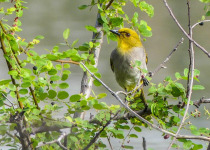
Yellow-throated Bulbul Most international flights arrive into Bangalore in the early morning. On arrival we will drive south to the Cauvery (Kaveri) Wildlife Sanctuary, named after the river that flows along its edge, and stay at the relaxing Galibore Nature Camp, run by the Government of Karnataka’s eco-tourism brand Jungle Lodges & Resorts. If your flight arrived early enough, or you spent the previous night in Bangalore, we may first stop en route at the Ramnagara Vulture Sanctuary where we will hopefully see some of the few remaining Indian Vultures in south India. This habitat of rocky, scrub-covered hills is good for Yellow-throated Bulbul: a bird that will be tough to find later if we don’t see it here, and the distinctive local form of Long-billed Pipit. We should arrive at Galibore in time for a late lunch and afternoon birding with local naturalists who are true experts in the wildlife of this area, many having been born in small villages nearby and will tell us about their exciting long walks through the jungle to and from school each day! We can also take a ride on the river in a coracle, the traditional round bamboo boat, which is an excellent way of exploring.
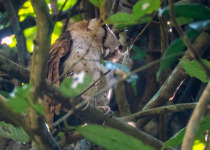
Our full day here will involve morning and afternoon bird walks, as well as plenty of time to relax in the well-appointed camp itself; you may well see the charming and rare Grizzled Giant Squirrel whilst lounging in your hammock! This is probably the best place in India to see this restricted range endemic. The riverine and scrub forests of the Cauvery Wildlife Sanctuary provide excellent birding, with many species that we won’t encounter in the different habitats on the rest of this tour. Prime amongst these is Lesser Fish Eagle, which was unknown in south India until they were discovered along this stretch of river, and we have a very good chance of seeing a pair here. Other fairly common birds that we should encounter include Blue-faced Malkoha, Green Imperial Pigeon, Stork-billed Kingfisher, Crested Treeswift, White-bellied Drongo, Jerdon’s Bushlark, and Jerdon’s Leafbird, whilst luck could bring us Painted Spurfowl, Painted Sandgrouse, White-naped Woodpecker, Marshall’s Iora and White-naped Tit. Night brings us a chance of multiple nightjar and owl species, and we may well see Indian Scops and Brown Hawk Owls at their daytime roosts.
After early morning birding and a full Indian breakfast, we will set off on the drive to Masinagudi. We have two possible routes depending on our preference for a birding stop. One is via the Ranganathittu Bird Sanctuary on a different stretch of the Cauvery River. A short boat ride is an excellent way of observing the colony of storks, egrets and cormorants, and we should also see Spot-billed Pelican, Painted Stork, Streak-throated Swallow, Great Thick-knee, River Tern and White-spotted Fantail. Alternatively, and especially if we have seen most of these riverine species at Galibore, we will take a cross-country route that takes us across the river at Talakadu. This is a historic site known for an ancient group of Hindu temples, most of which are now buried in sand, and from a birding viewpoint occasionally hosts wintering Black-bellied Terns. Either route takes us through Bandipur and Mudumalai National Parks, and provides lots of potential for en-route birds, although unfortunately we are not allowed to stop inside the National Parks. Outside though we will try a few brief stops, particularly where there is good dry scrub habitat which may produce species such as Yellow-wattled Lapwing, Jerdon’s Bushlark, Blue-winged (Malabar) Parakeet, Small Minivet, Black-headed Cuckooshrike and Ashy-crowned Sparrow Lark. Our accommodation at Jungle Hut in Masinagudi has excellent birding in its grounds where we can relax before visiting another nearby scrub habitat later in the afternoon.
Malabar Lark Today is a full day of birding in the excellent scrub habitat of Mudumalai, particularly in the Masinagudi area. The regionally scarce White-bellied Minivet will be a key target here, whilst we will also be searching for birds such as Red Spurfowl, Brown Fish Owl, Blue-faced Malkoha, Blue-bearded Bee-eater, White-naped Woodpecker, Indian Pygmy Woodpecker, Indian Nuthatch and Malabar Lark.
After a final morning birding session in Masinagudi, we head to our next destination: Udagamandalam, more commonly known as Ooty, situated at an altitude of about 2,200m. Ooty was originally occupied by various hill tribes of the region, and later became a popular destination during the British colonial period. After independence, it has become a popular holiday destination due to its beautiful hills and forests, pleasant climate, and locally made chocolate!
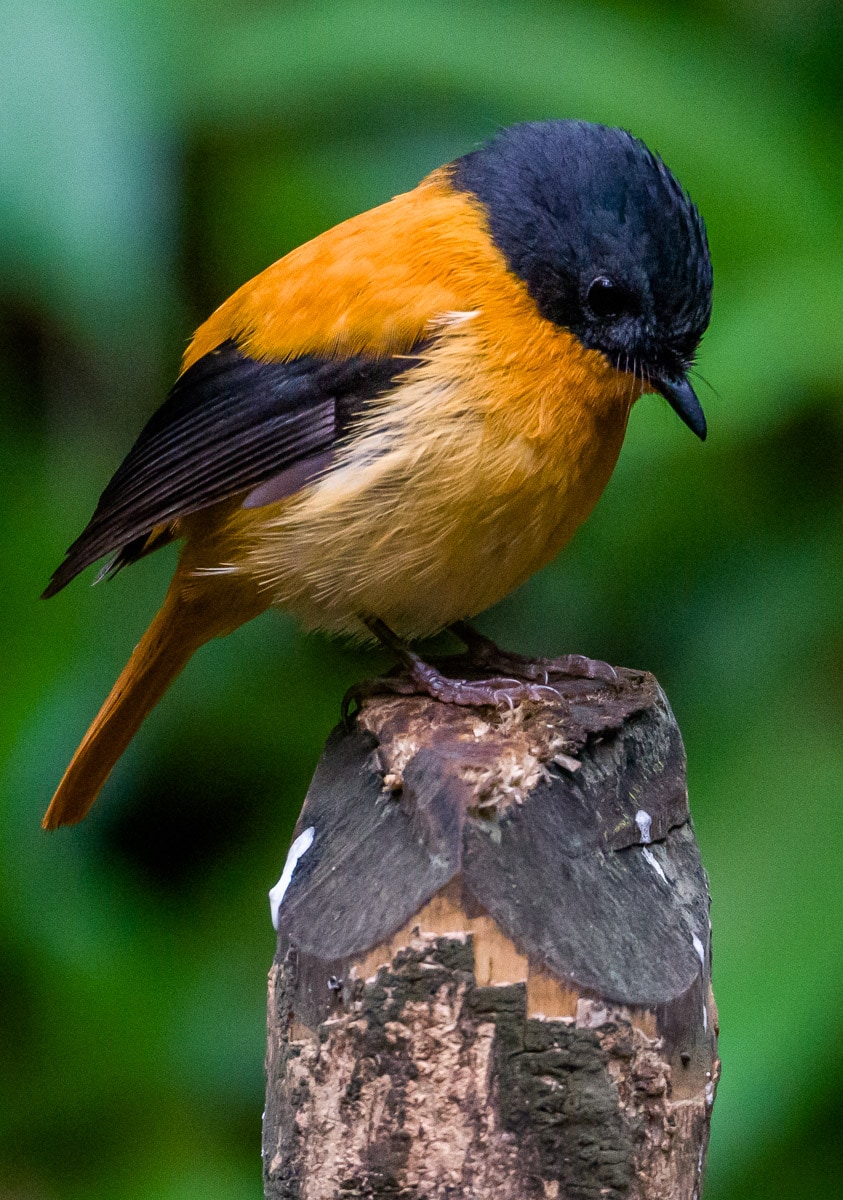
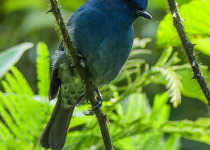
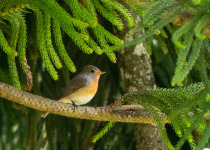
Nilgiri Flycatcher We have a full day to bird various sites in the Ooty area, particular concentrating on remnant forest patches amongst the extensive tea estates. Key species here include Indian Blue Robin, Indian Blackbird, Nilgiri Sholakili (Nilgiri Blue Robin), Kashmir Flycatcher, Nilgiri Flycatcher, Black-and-orange Flycatcher, Tytler’s Leaf Warbler, Nilgiri Wood Pigeon and Painted Bush Quail.
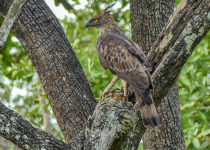
Hopefully having seen most of Ooty’s specialities we will make an early start for Parambikulam Tiger Reserve in the Nelliampathy and Annamalai Hills in Kerala. This is excellent forest habitat, contiguous with the Indira Gandhi National Park in Tamil Nadu, which we will pass through at Top Slip. In the late afternoon there is a good chance of seeing Great Hornbill, which often perch prominently in tall trees before flying off to roost. We will also look to see Indian Pitta, Malabar Trogon, Emerald Dove, Grey-fronted Green Pigeon, Malabar (Crimson-fronted) Barbet, Orange Minivet, the scarce Grey-headed Bulbul, Malabar Starling, Brown-breasted Flycatcher and Thick-billed Warbler.
With a local forest guard who will keep a keen eye and ear out for elephants, we will enjoy an early morning trek through the beautiful forest at Parambikulam and are certain to add a few more Western Ghats forest specialities. After that it is time to head back up into the hills again at Munnar, but with a birding stop on the way at Chinnar Wildlife Sanctuary. This is one of the few dry scrub habitats in Kerala and gives us another chance of Yellow-throated Bulbul if we were unable to connect with that on our first day. One trail here follows the river where we have an outside chance of seeing the impressive Spot-bellied Eagle-Owl. Other species include Malabar Whistling Thrush, Brown Fish-owl, Western Crowned Leaf-warbler, Tickell’s Blue Flycatcher and Asian Paradise Flycatcher. We will probably arrive after dark if we have spent long birding at Chinnar but, if it is still late afternoon, we’ll break for a tea stop at Karadippara, which provides an excellent vantage point across the extensive wooded valley. Species here might include Yellow-browed Bulbul, Crimson-backed Sunbird, Grey-fronted Green Pigeon (formerly Pompadour Green Pigeon), Little Spiderhunter, Brown-cheeked Fulvetta and Rusty-tailed Flycatcher.
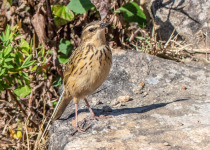
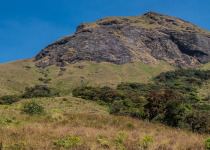
Nilgiri Pipit Around Munnar, the pockets of the shola forest (the high-altitude montane forests amongst the grassland) and mountain grassland ecosystem are home to several endemic birds and various mammals including Nilgiri Tahr. The altitude above 1600 m means an agreeable climate throughout the year, although in December and January the temperatures can fall to single digits: a slight reminder of the European winter you may have escaped to come here! Rainfall of over 300 cm per year is recorded mainly during June to September, but in these cloud forests it can rain at any time of year. Here we will look for several more South Indian and Nilgiri Hills endemics. Target species around Munnar include Palani Laughingthrush (formerly Grey-breasted Laughingthrush), White-bellied Sholakili (formerly a Blue Robin, and before that a Shortwing!), Nilgiri Pipit, Nilgiri Wood Pigeon and, especially, Broad-tailed Grassbird: a fairly easy species to find in the monsoons but can be tough at this time of year.
After breakfast we will drive south to Periyar National Park, arriving before lunch. Periyar has a wide variety of habitats including grassland, and dry deciduous and evergreen forest, and riverside scrub. Consequently, it has an excellent variety of species, including Brown-backed Needletail, Black Eagle, Besra, Mountain Imperial Pigeon, Yellow-browed Bulbul, Thick-billed Warbler, Asian Fairy Bluebird and Little Spiderhunter. Although fairly widespread in the Western Ghats one of the most difficult endemics to see is Wayanad (or Wynaad) Laughingthrush. Periyar is one of the most reliable places for it, but we will need to be very lucky to get good views of this fast-moving skulker.
One of the highlights of Periyar is a jeep safari in the Gavi Forest, which gives us an excellent tour of the landscape of tropical forests, grasslands and sholas. As well as birds we hope to see some interesting mammals such as Lion-tailed Macaque, and there is a slight chance of coming across one of Periyar’s estimated 35 Tigers. In the afternoon we will probably take a boat across the lake, which may well treat us to a family of Asian Elephants coming for a drink.
Today we leave Periyar and head back north to Thattekad Bird Sanctuary. An evergreen lowland forest, Thattekad is located between the branches of the Periyar River, making for a perfect birding mix of forest and wetland habitats. Areas both inside and outside of the actual sanctuary are well-known as one of the best birding sites in the Western Ghats. Our afternoon birding might find Fork-tailed Drongo Cuckoo, Black-throated Munia, Red Spurfowl and, one of the specialities here, Black Baza. Late afternoon activity, particularly around a small drinking puddle, sometimes produces close views of some good passerine species, including Indian Blue Robin, Blue-throated and Tickell’s Blue Flycatchers, Puff-throated Babbler and Orange-headed Thrush, and even a Slaty-legged Crake. Brown-breasted Flycatcher, Malabar Trogon, Malabar Parakeet all occur locally.
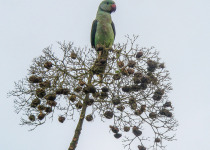
Blue-winged Parakeet Two full days of quality birding in Thattekad will bring us plenty of species, and we’ll aim to find those Western Ghats birds that we may have missed up until now. A spot of night-birding could produce Great Eared as well as Jerdon’s Nightjar, and Spot-bellied Eagle Owl and Sri Lanka Bay Owl. These owls are difficult though: we will hope one of our local guides has managed to find a day roost for the latter, although even then they tend to use different sites every few days and our chances are slim! Key species: Oriental Dollarbird, Indian Pitta, Malabar Woodshrike, Great Hornbill, Mountain Imperial Pigeon, Crested Goshawk, Blue-winged Parakeet, Jerdon’s Nightjar, White-bellied Blue Flycatcher, Blue throated Blue Flycatcher, Black-naped Oriole, Grey-headed Bulbul.
The final day of our tour is likely to still include some good birding before we head to Kochi for the flight home. Most international flights are in the evening so there is still time to complete any gaps in our list! Of course, if you haven’t had your fill of India’s endemic birds then our short trip to the Andaman Islands is an ideal extension to this tour.
Locations & map
- Western Ghats - Karnataka / Kerala / Tamil Nadu India (Conditions vary by season and exact route.)
Included
- Experienced local birding guide support - Exact guide assignment to confirm.
- Tour services described in the confirmed itinerary - Final inclusions are set in the operator quotation.
Not included
- International flights - Not included.
- Visa, travel insurance and personal expenses - Traveller responsibility.
Transport & stays
- Private ground transport and domestic connections Exact vehicle, flight and transfer plan to confirm for the chosen itinerary. | Pickup: Airport or hotel pickup where included in the confirmed plan.
Policies & FAQ
Can this tour be arranged privately?
Yes. Bubo Birding states that its published itineraries can be arranged as private trips, with dates and details tailored to the group.
Are the price and itinerary final?
No. Current availability, group assumptions, accommodation, exact routing and the final quotation should be confirmed after sending an inquiry through BirdWatch.info.