
Birds & Mammals of Assam
This short tour visits one of the most beautiful parks in India’s Northeast, followed by the best-known. Manas National Park, named after the Manas River, is a tiger reserve on the Bhutan border, and part of an important elephant corridor. This is a birding-focused tour in India.
About this tour
This short tour visits one of the most beautiful parks in India’s Northeast, followed by the best-known. Manas National Park, named after the Manas River, is a tiger reserve on the Bhutan border, and part of an important elephant corridor. It has a fantastic selection of mammals including the gorgeous Golden Langur. For birds it is a prime site for the critically endangered Bengal Florican, and we will also look for Swamp Francolin, Wreathed Hornbill, Red-headed Trogon, Silver-breasted Broadbill, Slender-billed Babbler, Sultan Tit and Black-breasted Parrotbill.
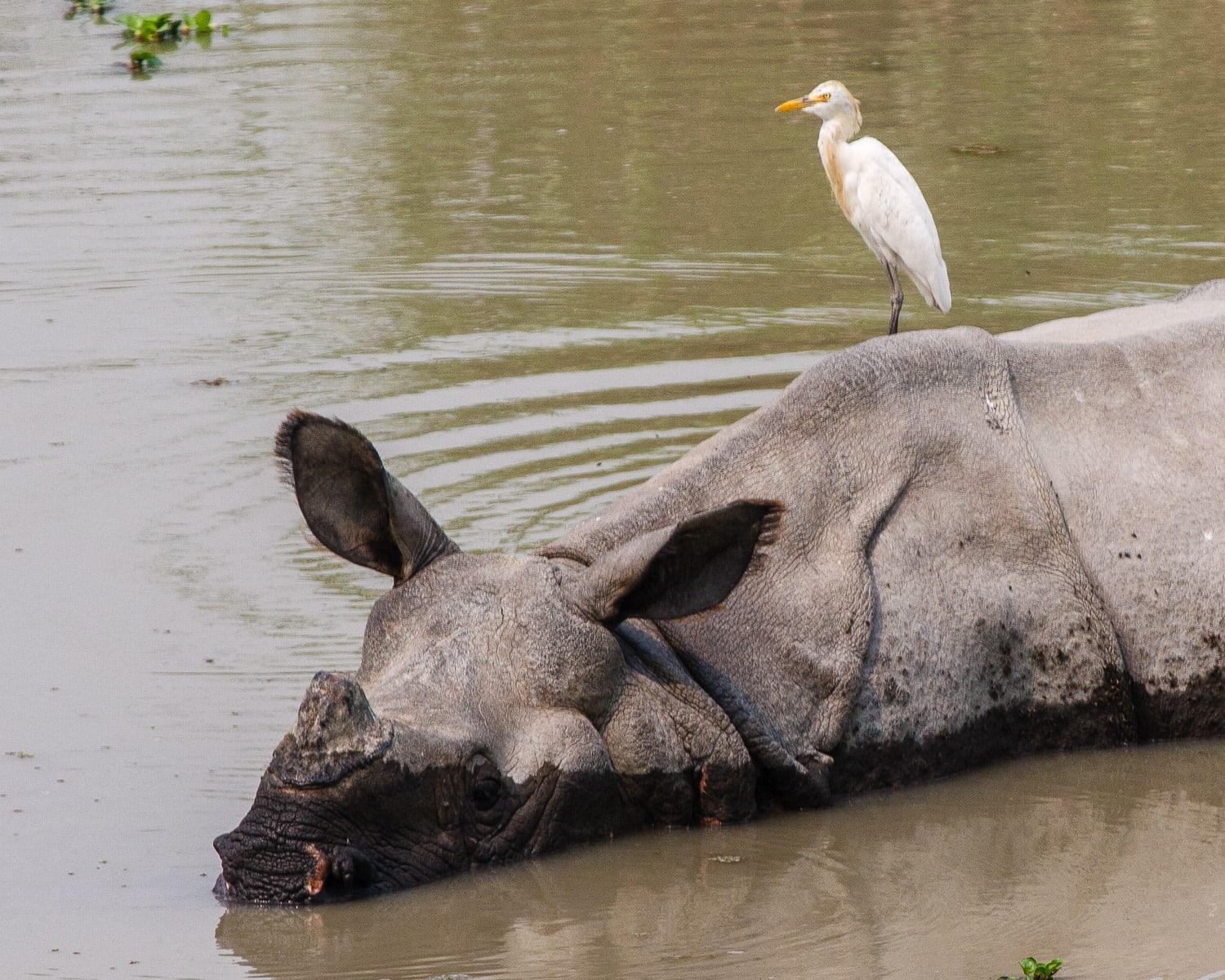
Kaziranga National Park is world-famous, in particular as the number one site for the endangered Indian Rhinoceros. This is also one of the best places to see Wild Water Buffalo and Asian Elephant, and there is a chance of seeing a Tiger, as well as several localised and endangered birds such as Swamp Francolin, Greater Adjutant, Pallas’s Fish Eagle, Great Hornbill, Indian Grassbird, and Finn’s Weaver.
This Bubo Birding itinerary is available through BirdWatch.info as a private or custom departure. Current dates, exact routing, accommodation and final price should be confirmed after inquiry.
Birds you can spot
Itinerary ▼
Depending on flight arrival time in Delhi, today will either include a flight on to Guwahati and overnight there, or a stay overnight in Delhi, with a late morning flight the following day.
For those of us who spent the night in Guwahati rather than Delhi, we will start the day with birding in the Guwahati area, e.g. at Deepor Beel or Garbhanga Reserve Forest, and the delightful Guwahati Garbage Dump: the best site in the world for the endangered Greater Adjutant! We then all drive to Manas National Park and check in to our lodge in time for an afternoon jeep safari. The Manas River, a tributary of the Brahmaputra, passes through the middle of the Park and gives it its name. In the foothills of the Himalaya, its varied landscape of grassland and forest is one of the most pristine and stunning in India. The National Park extends into Bhutan as the Royal Manas National Park, and is a sanctuary for various endangered species, including Golden Langur, Hispid Hare, Pygmy Hog and Clouded Leopard. Other mammals here include Asian Elephant, Indian Rhinoceros, some of the few remaining Wild Water Buffalo, Asian Golden Cat, Capped Langur and Hoolock Gibbon.
Our full day in Manas will mean jeep safaris morning and afternoon, in search of both mammals and birds. We will particularly look for the critically endangered Bengal Florican, although outside of the breeding season it rarely strays out of the deep grass and in to the open so we will require some luck to get good views, probably from one of the park’s viewing towers. Other grassland birds to look out for include Pied Harrier, White-eyed Buzzard, Collared Falconet, Swamp Francolin, Chestnut-capped Babbler, Finn’s Weaver, Bengal Bush Lark, Hodgson’s Bush Chat, Black-breasted Parrotbill, and Indian (Rufous-rumped) Grassbird. The surrounding forest has equally good birding, with Wreathed, Oriental Pied and Great Hornbills, Rufous-bellied Hawk Eagle, Orange-breasted, Pin-tailed and Ashy-headed Green Pigeons, Barred Cuckoo-dove, Green-billed Malkoha, Red-headed Trogon, Blue-bearded Bee-eater, Lineated Barbet, Long-tailed and Silver-breasted Broadbills, Crested Kingfisher, Assam, Greater Necklaced and Rufous-necked Laughingthrushes, Scaly Thrush, Sultan Tit, Slaty-backed Forktail, Yellow-vented Flowerpecker and Chestnut-eared Bunting all possibilities.
We will drive to Nameri National Park and Tiger Reserve and get some late afternoon birding in. If we have time, we will cross the Jia Bhoreli river by boat and approach quietly to some of the swampy pools to hopefully get a glimpse of the endangered White-winged Duck. Nameri is the best place in India to see this species, although they are shy forest-dwelling ducks and often fly off at the slightest noise on approach to one of the other many, inaccessible, pools deep within the forest.
A further morning in the lowland forest of Nameri should produce an excellent variety of species, potentially including White-cheeked Partridge, Pin-tailed Green Pigeon, Lesser Coucal, Great Thick-knee, Ibisbill, River Lapwing, Long-billed Plover, Small Pratincole, Pallas’s Fish Eagle, White-rumped and Slender-billed Vultures, Great and Wreathed Hornbills, Crested Kingfisher, Pied Falconet, Oriental Hobby, Maroon Oriole, Sultan Tit, Scaly Thrush and Siberian Rubythroat. We then leave on the relatively short drive to Kaziranga National Park, where we will spend the next two days.
Kaziranga National Park extends over 480 sq km with the great Brahmaputra River as its northern boundary and the Karbi Hills fringing the southern. The name Kaziranga means means ‘where the mountain goat drinks water’ in the language of the Karbi tribe. It used to be an inaccessible swampy land covered with tall elephant grass and jheels (water bodies). Now a National Park, it is famous for its 1,000-strong population of Indian Rhinoceros, Wild Water Buffalo and Asian Elephant. Kaziranga is divided into three ranges. The central range is usually the best to see Indian Rhinoceros, Wild Water Buffalo and Asian Elephant in the water. The eastern range offers some of the most exciting and varied wildlife watching, with a possibility of seeing Otters and, with luck, a Tiger. A great variety of waterfowl should be present at Sohola Bheel, where we also hope to see Greater Adjutant Stork, Pallas’s and Grey-headed Fishing Eagles and Spot-billed Pelican. Overall an impressive list of species could also include Falcated Duck, Ferruginous Duck, Swamp Francolin, Bengal Florican, Lesser Coucal, Plaintive Cuckoo, Black-necked Stork, Lesser Adjutant, Great and Oriental Pied Hornbills, Blue-bearded Bee-eater, Blossom-headed Parakeet, Blue-naped Pitta, Chestnut-capped Babbler, Great Myna, Pale-chinned Blue Flycatcher, Crimson Sunbird and Finn’s Weaver>.
From Kaziranga we drive back to Guwahati for our onward flight to Delhi where the tour ends. Alternatively, this tour can easily be combined with another of our Northeast India tours.
Included
- Experienced local birding guide support - Exact guide assignment to confirm.
- Tour services described in the confirmed itinerary - Final inclusions are set in the operator quotation.
Not included
- International flights - Not included.
- Visa, travel insurance and personal expenses - Traveller responsibility.
Transport & stays
- Private ground transport and domestic connections Exact vehicle, flight and transfer plan to confirm for the chosen itinerary. | Pickup: Airport or hotel pickup where included in the confirmed plan.
Policies & FAQ
Can this tour be arranged privately?
Yes. Bubo Birding states that its published itineraries can be arranged as private trips, with dates and details tailored to the group.
Are the price and itinerary final?
No. Current availability, group assumptions, accommodation, exact routing and the final quotation should be confirmed after sending an inquiry through BirdWatch.info.