
North Sikkim Birds
North and East Sikkim are not regularly visited by birders but provide an excellent variety of East Himalayan birds that are often more confiding and easier to see than in the more popular sites in Arunachal Pradesh.
About this tour
North and East Sikkim are not regularly visited by birders but provide an excellent variety of East Himalayan birds that are often more confiding and easier to see than in the more popular sites in Arunachal Pradesh.
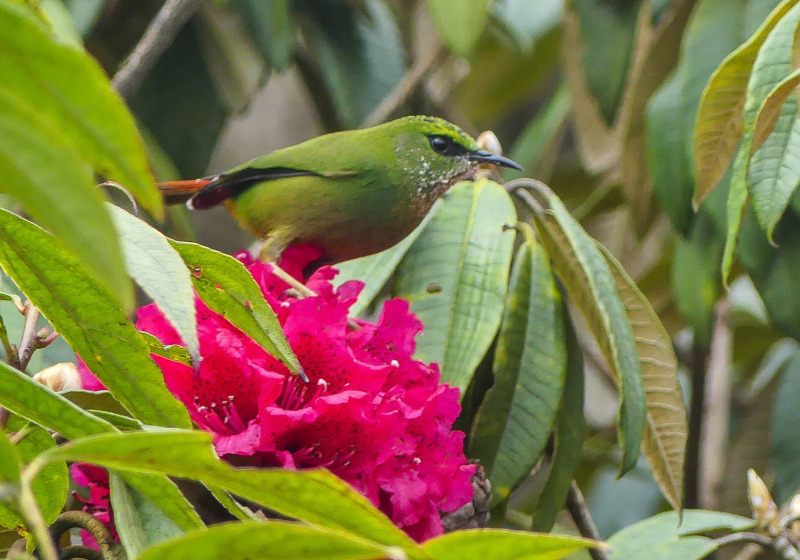
The first few days of this tour are spent in Pangolakha Wildlife Sanctuary, close to western Bhutan. The sanctuary covers a vast altitudinal range, to over 4,000 m, bringing with it many changes in birdlife as we ascend through the rhododendron and juniper forest to the alpine lakes. We will make use of one or two simple homestays in the area and have time to explore thoroughly, from lower areas around Phadamchen through the famous zigzag roads of Zuluk to the Nathang Valley. Speckled Wood Pigeon, Bay Woodpecker, Slaty-backed Forktail, White-collared Blackbird, Scaly Thrush, Black-throated Thrush, Blue-winged Laughingthrush, Rufous-breasted and Maroon-backed Accentors, Red-tailed Minla, Hoary-throated Barwing, White-browed Fulvetta and Large Niltava are some of the birds we can expect, with Himalayan Monal, Blood Pheasant, Fire-tailed Myzornis, Long-tailed Broadbill, Brown and Great Parrotbills some of the more desirable targets.
Most of us enjoy beer and birds (although not usually at the same time) and in this area we will be able to sample the local beer substitute ‘chang’, a hot drink made from fermented millet, and typically drunk from a bamboo mug.
After our stay in the East we will head North to the Tibetan plateau for a completely different birdlife. This is relatively unexplored territory and a land of pheasants, snowfinches and swarming flocks of Grandalas! Blood Pheasant, Snow Partridge, both Himalayan and Tibetan Snowcocks are all likely, Black-winged (Tibetan), White-rumped and the lovely Rufous-necked Snowfinch occur in flocks, and there is little that can beat the sight of hundreds of shiny blue Grandalas against a snowy backdrop.
This area is excellent for mammals and we will look for herds of Kiang, the Tibetan Wild Ass, as well as Himalayan Serow, Tibetan Sand Fox, and even a Pallas’s Cat.
This Bubo Birding itinerary is available through BirdWatch.info as a private or custom departure. Current dates, exact routing, accommodation and final price should be confirmed after inquiry.
Birds you can spot
Itinerary ▼
Assuming an early morning arrival in Delhi, today will include a flight on to Bagdogra in West Bengal ready for an early start the following day. If your international flight arrives later then you should come the day before, and we can provide accommodation and some productive local birding.
We leave early morning from Bagdogra for the drive north into Sikkim, where we will arrange our permits and then continue on to our homestay in one of the villages of Nimachen, Phadamchen or Zuluk. We will have time for some afternoon birding in the forest areas en route.
Our three full days in the Pangolakha Wildlife Sanctuary will be spent covering both high and low altitudes, guaranteeing us a large variety of species and some superb birding and scenery. The lower areas include Keukhola Falls, literally ‘potato waterfall’ in Nepali, where locals used to wash the potatoes grown nearby. Higher up we will drive the famous zig-zag road, and bird the stretch from Zuluk to the Thambi Viewpoint, to Lungthu and Kupup, and the beautiful high altitude Kupup Lake, also known as Elephant Lake due to its shape. This area is part of the ancient Silk Route through Sikkim, which passed through China and Lhasa in Tibet, into India at Nathu La, and to the sea in West Bengal at the ancient port of Tamralipta, now Tamluk. It may well be the pheasants that prove to be the stars of our time here, with Blood Pheasant, Himalayan Monal and Satyr Tragopan all occurring here. Or maybe it will be flocks of warblers, laughingthrushes, parrotbills and rosefinches? We will try for species including Snow Pigeon, the fabulous Fire-tailed Myzornis, Chestnut-crowned Warbler, Lesser Necklaced, Scaly and Black-faced Laughingthrushes, Black-throated, Great and Brown Parrotbills, Himalayan Shortwing, Golden Bush Robin, Slaty-backed Forktail, Collared Grosbeak, Dark-breasted and Himalayan White-browed Rosefinches. Experiencing local food and drink is a great aspect to travel and understanding local culture, and here in the evenings we can try some ‘chang’, a fermented drink made from finger millet, and traditionally served in a bamboo vessel or ‘tongba’, and drunk through a bamboo straw. Go easy though: we have an early start and lots of birds to see!
We will spend the day birding various areas on the way to Gangtok, where we will arrive for an overnight stay.
Leaving early, we first drive to Ganesh Tok temple on the outskirts of the city. Here we can expect more forest birds from these mid elevations, including Red-billed Leiothrix, Blue-winged and Chestnut-crowned Laughingthrushes, Rufous-capped Babbler and Streak-breasted Scimitar-Babbler. We then start the drive north, and up in elevation, to Lachen, arriving late afternoon with plenty of en route birding. This will include in the tropical forests between Singhik to Chungthang, and the more temperate forest from there to Lachen.
Lachen is our base for birding on the extensive Sikkim or Tso Lhamo plateau, in the Trans-Himalayas, and the alpine juniper and rhododendron forest on the way there. Unfortunately, the Gurudongmar Lake area is inaccessible for foreigners, but there is plenty of good birding that is open to us. This area is home to some highly threatened mammals, and we will see herds of Kiang, or Tibetan Wild Ass, and could also encounter Tibetan Antelope, Tibetan Gazelle, Himalayan Serow, Tibetan Argali and even the wonderful Pallas’s Cat. In this arid high-altitude landscape birds include Tibetan Snowcock, Blood Pheasant, Snow Partridge, Bearded and Himalayan Vultures, Tibetan Sandgrouse, Ground Tit, Spot-winged and White-winged Grosbeaks, flocks of White-rumped and Rufous-necked Snowfinches, and Brown Accentor. Whatever we see, it will be difficult to beat the highlight of a brilliant blue flock of Grandalas which we will hope to encounter!
Lachen is the base for the Chopta Valley, and the Thangu Valley further north. Today we move on to explore the next valley eastwards, to Lachung, on the edge of the Yumthang Valley Natural Reserve, where we will arrive before lunch. East of Lachung we will explore the winding road to Katao, nearing the Bhutan border.
Whilst based in Lachung we will bird various areas, including the Yumthang river where we may find Ibisbill and White-throated Dipper, and Singba Rhododendron Sanctuary. Possible species for the day include Speckled Wood Pigeon, White-throated Redstart, Long-billed Thrush, Red-throated Thrushes amongst the Black-throated Thrushes and White-collared Blackbirds, Maroon-backed Accentor and Sikkim Treecreeper.
For the afternoon we will bird in the Fambong Lho Wildlife Sanctuary, before we reach Gangtok in the evening. This is an oak forest with rhododendron and bamboo and can be excellent for laughingthrushes, with Grey-sided, Scaly and Spotted, and Red-faced Liocichla, all possible. We will also look out for Short-billed Minivet, Rufous-throated Wren Babbler, Rusty-fronted Barwing, Rusty-cheeked Scimitar Babbler, Grey-bellied Tesia, Grey-sided Bush Warbler, Golden Bush Robin and Fire-tailed Sunbird.
We have some flexibility today as we leave Sikkim and drive back to West Bengal, and will decide based on what we have and haven’t seen on the tour. If we don’t delay too long with our morning birding we may head to some completely different habitat, the Teesta River, and bird near the Gajoldoba barrage. A small wetland area here concentrates many ducks and other waterbirds, including a remarkable number of Indian rarities. Whilst we are too early in the winter to expect the rarer ducks, we could still get lucky with something like Eastern Spot-billed or Falcated Duck, or Black-necked Grebe. Great Thick-knee, Grey-headed and River Lapwings, Small Pratincole, Pallas’s Gull, Pied Harrier, Collared Falconet, Sand Lark, Striated Grassbird, Siberian Rubythroat, Citrine Wagtail, and Rosy and Richard’s Pipits are other possibilities. We are at a very interesting time of year for migration generally, and this area is little explored, so we should expect the unexpected! Late in the afternoon we should have some time for birding at Mahananda Wildlife Sanctuary, and will stay overnight near here. Species variety in this lowland forest is excellent, and we can expect to see a wide variety of species, such as Red Junglefowl, Small Pratincole, Crested Treeswift, Green-billed Malkoha, Red-breasted Parakeet, Rufous-necked, Oriental Pied and Great Hornbills, Long-tailed Broadbill, Little Pied Flycatcher, Orange-bellied Leafbird and Common Green Magpie.
After a morning’s birding in Mahananda we head the short distance to Bagdogra to catch our afternoon flight to Delhi.
Locations & map
- North Sikkim - Sikkim India (Conditions vary by season and exact route.)
Included
- Experienced local birding guide support - Exact guide assignment to confirm.
- Tour services described in the confirmed itinerary - Final inclusions are set in the operator quotation.
Not included
- International flights - Not included.
- Visa, travel insurance and personal expenses - Traveller responsibility.
Transport & stays
- Private ground transport and domestic connections Exact vehicle, flight and transfer plan to confirm for the chosen itinerary. | Pickup: Airport or hotel pickup where included in the confirmed plan.
Policies & FAQ
Can this tour be arranged privately?
Yes. Bubo Birding states that its published itineraries can be arranged as private trips, with dates and details tailored to the group.
Are the price and itinerary final?
No. Current availability, group assumptions, accommodation, exact routing and the final quotation should be confirmed after sending an inquiry through BirdWatch.info.